
Your board sees NRR every quarter. Make sure it tells the right story.
Most health scores describe the past. This domain is about the signals that arrive early enough for someone to do something about them, on read-only access to your CRM and product data until you say otherwise.
A health score that goes green right up to the churn.
A health score built on logins and ticket counts goes green right up to the churn. The renewal conversation starts when the renewal date arrives, which is too late to change the outcome.
CSMs run on instinct because the platform tells them what happened rather than what is about to. The fix is to name the signals that actually precede a loss, and to escalate on them rather than on the calendar.
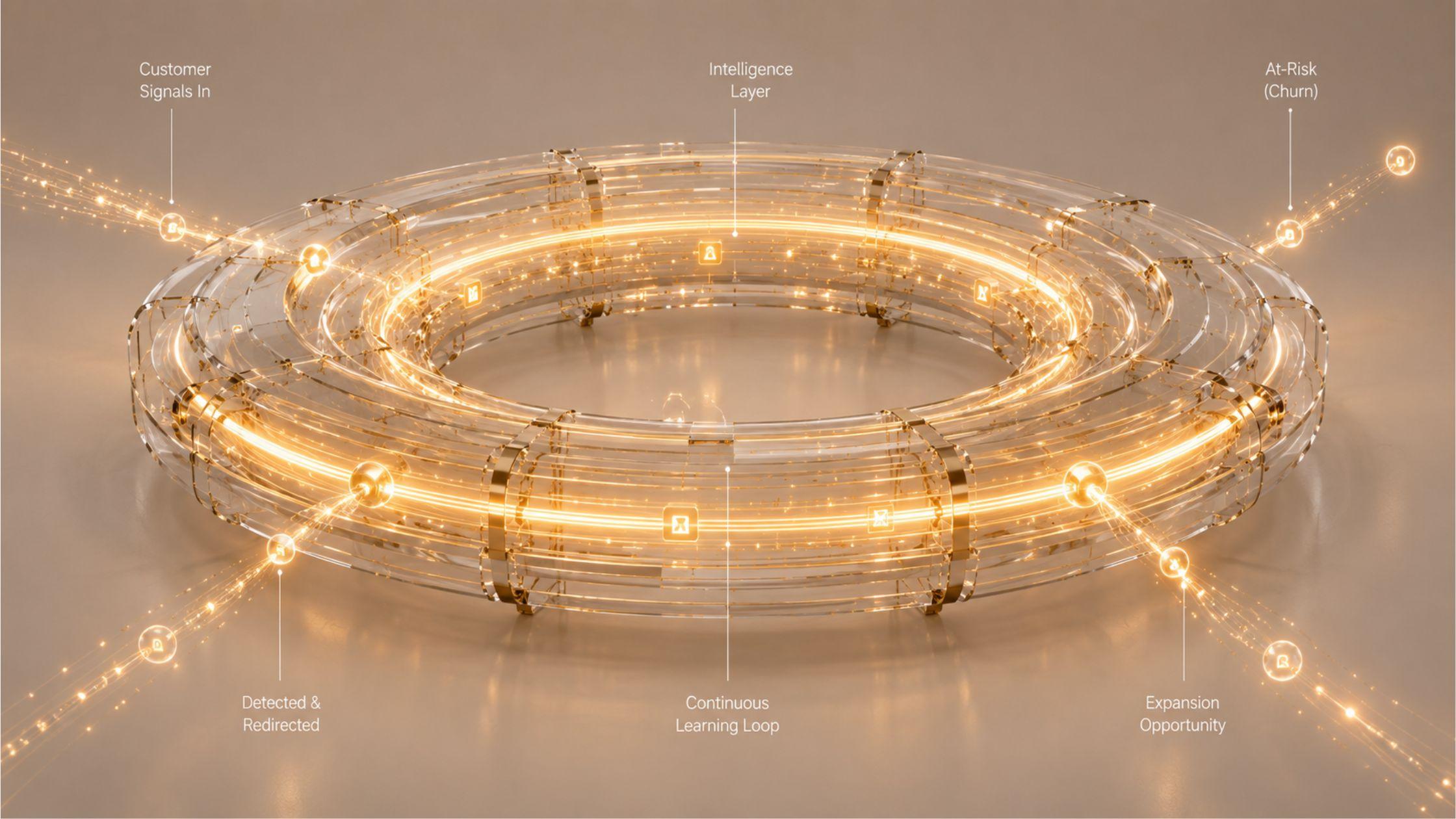
Retention is a loop, not a date in the calendar.
Every system in this domain sits on one of these stages. The audit names which one is costing you the most.
Two named systems. Each one carries a limit, in writing.
Working software an engineer builds inside your stack and hands over. The audit decides which of the two comes first.
Churn Signal Watchtower
It watches what happens before an account leaves: the champion who stopped logging in, the second ticket on the same problem, the seat count that quietly dropped. Not the aggregate that hides all three.
What gets built. A ranked list of accounts showing early risk, each with the specific signal that raised it and when it fired.
Renewal Radar
It tracks every renewal against the runway a save actually needs, and escalates on the signal rather than on the calendar. A CSM hears about a wobbling account in week six, not week fifty.
What gets built. A rolling renewal view with a named owner and an escalation date per account, driven by risk rather than by the contract date.
Nothing here goes live until it passes on your data.
Each system is graded against about twenty real accounts from your own history, including the ones that churned, run twice, before it flags anything. Its freedom widens only while the numbers hold.
Below it, or on any unsafe action, it does not ship, and we tell you exactly why. You get the score as a document. The fee buys the truth, not a pass.
Retention starts at the handover, not at the renewal.
Where closed-won hands over
An account that was mis-sold is already at risk on day one. Pipeline Hygiene Sentinel and Forecast Assistant.
See the domainRevenue IntelligenceWhere NRR is assembled
Churn and expansion only become a number someone can defend once they are counted the same way every quarter.
See the domain
Start with the Revenue Leak Report.
Three weeks on read-only access to your Salesforce or HubSpot. It ends with artefacts, not a deck, and every finding states the assumption behind it so your team can argue with the method.
- Every leak in dollars, not in adjectives
- An Operating Map, naming which system fixes what
- A prioritised sequence, with the assumption behind each call
- Yours to keep, whether or not you build with us
Which of the two first?
The Revenue Leak Report answers that. Three weeks on read-only access, every leak quantified in dollars, and the one system that stops the biggest one named. Yours to keep either way.
- Three weeks, fixed scope
- Read-only Salesforce or HubSpot
- An Operating Map you keep
Prefer email? contact@vandfort.com